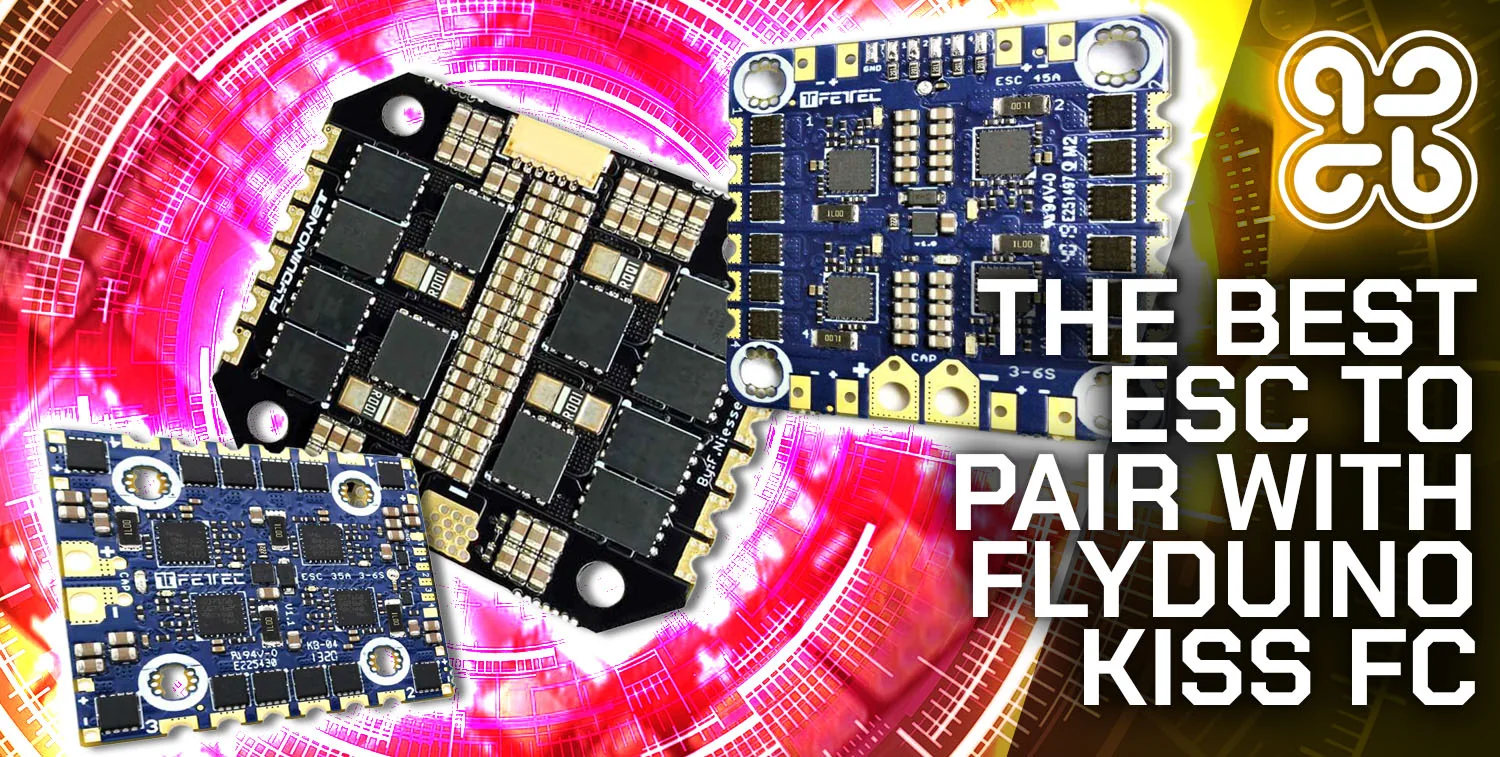
So you decided to build a Kiss quad? Trust me when I say that this is a fantastic decision, but which ESC is best? This article has the answers!
Looking for quick answers? Check out the comparison table.
One of the best things about Kiss is that it completely lives up to its name. Keep It Super Simple.
Keep It Super Simple
The whole concept of Kiss is to prioritise simplistic design in order to ensure reliability of a system.
Kiss FC has adopted this policy beautifully. Although it is a closed source platform, it is also simplistic, reliable and it performs superbly in the air.
What ESCs Can I Use With Kiss FC?
Unlike with Betaflight, there is not an overwhelming number of choices when it comes to ESCs to use with Kiss.
The reason for this is that Kiss is a closed source platform. Only authorised companies are able to develop hardware for the Kiss ecosphere.
In fact at the time of writing, the only official hardware available is from the Kiss developers, Flyduino, or from one other authorised third party, FETtec.
Here is a summary of the choices, if you already have an ESC in mind, feel free to jump ahead to the section for that particular one.
- Kiss ESC 2-5S 25A
- Kiss ESC 3-6S 32A
- Kiss ESC 2-5S 25A 4 in 1
- Kiss ESC 2-5S 24A Race Edition
- FETtec 4in1 ESC 45A
- FETtec 4in1 ESC 35A
There are also some all in one solutions that have the flight controller and ESC on the same board, however I feel these should be covered separately.
Our primary goal here is to conclude the best choice of ESC for a ubiquitous 5-inch racing or freestyle quad, as well as for 6-inch and 7-inch builds.
Having shortlisted the ESCs only, there are two types in the list above, both of which could be suitable for our build.
Standard ESCs
These come in a small rectangular form factor and are designed to drive one motor. We need 4 of these to be placed on each arm of the quad.
Pros
- If one ESC is damaged, only one needs to be replaced
- ESC is positioned in prop strike location, wires less likely to be damaged in a crash
Cons
- Double the amount of soldering required
- Will not fit on frames with slimmer arms
- More bulky, requires PDB, more weight
Our options for Kiss standard ESCs are as follows.
4 in 1 ESCs
These come in the 30 x 30 or 20 x 20 flight stack form factor. They can be stacked with the flight controller.
Pros
- Less bulky and lighter in weight
- Fits on top of flight controller for a cleaner build
- Will fit in any frame
- A lot less soldering than seperate ESCs
Cons
- If one ESC blows then whole 4 in 1 ESC must be replaced
Our options for Kiss 4 in 1 ESCs are as follows.
The List of ESCs Compatible With Kiss
Kiss ESC 2-5S 25A
- 32-Bit-ARM Cortex M4 MCU @ 80 MHz
- Telemetry Capability (voltage, current, temperature and RPM)
- Over current and over temperature protection
- Sine wave commutation
- Dshot 2400
- 25A continuous current (40A max burst)
- No additional capacitor required (for 3-5S)
- Regenerative braking
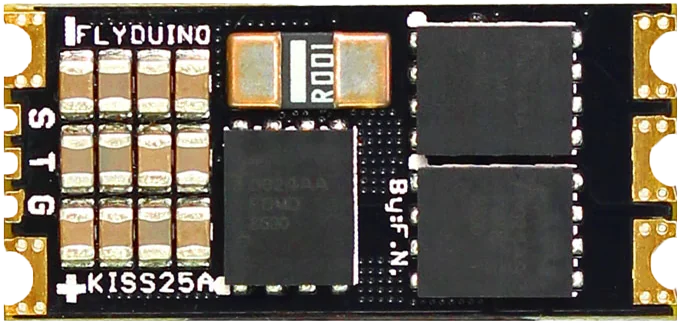
Kiss ESC 2-5S 25A
Check latest prices:
[Flyduino]
Kiss ESC 3-6S 32A
- 32-Bit-ARM Cortex M4 MCU @ 80 MHz
- Telemetry Capability (voltage, current, temperature and RPM)
- Over current and over temperature protection
- Sine wave commutation
- Dshot 2400
- 32A continuous current (45A max burst)
- No additional capacitor required (for 3-5S) (220uF 50V for 6S)
- Regenerative braking
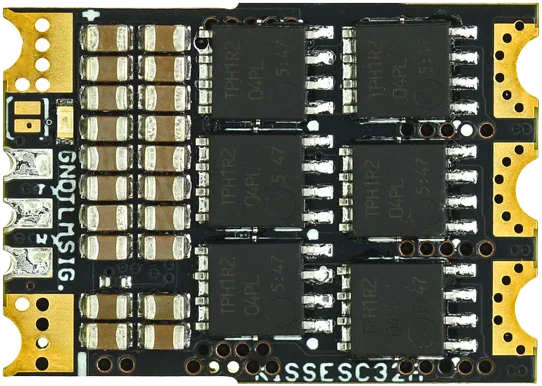
Kiss ESC 3-6S 32A
Check latest prices:
[Flyduino]
Kiss ESC 2-5S 25A 4 in 1
- 32-Bit-ARM Cortex M4 MCU @ 80 MHz
- Telemetry Capability (voltage, current, temperature and RPM)
- Over current and over temperature protection
- Sine wave commutation
- Dshot 2400
- 25A continuous current (40A max burst)
- No additional capacitor required (for 3-5S)
- Regenerative braking
- 70um PCB copper thickness for high current areas as low current control circuit is on a separate PCB
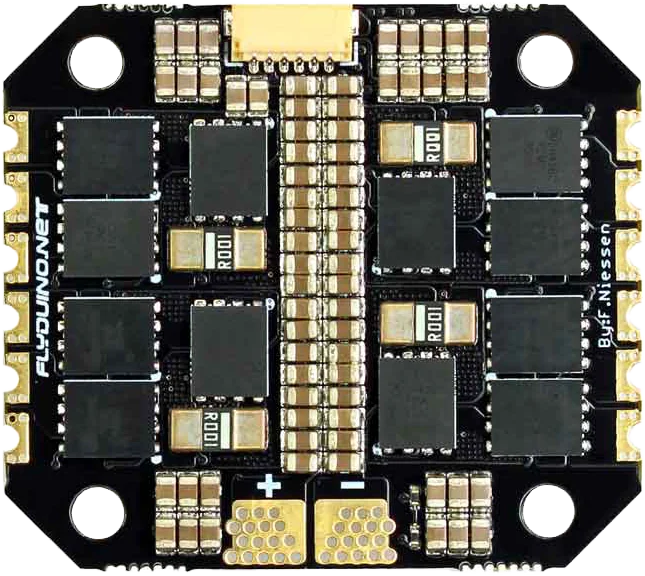
Kiss ESC 2-5S 25A 4 in 1
Check latest prices:
[Flyduino]
Kiss ESC 2-5S 24A Race Edition
- 32-Bit-ARM Cortex M4 MCU @ 48 MHz
- Telemetry Capability (voltage, current, temperature and RPM)
- Over current and over temperature protection
- Sine wave commutation
- 24A continuous current (does not require cooling)
- 35A max burst
- No additional capacitor required, although 100-400uF low ESR recommended
- Regenerative braking
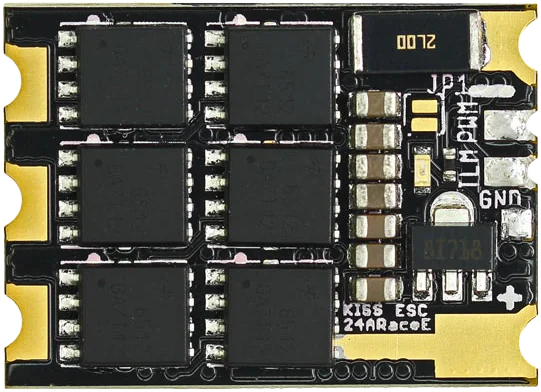
Kiss ESC 2-5S 24A Race Edition
Check latest prices:
[Flyduino]
FETtec 3-6S 4in1 ESC 45A
- STM32G071 @ 64MHz
- Over current and over temperature protection
- Sine wave commutation
- 128kHz PWM
- Automatic input signal detection:
- Dshot 300-2400
- PWM
- OneShot 42/125
- OneWire BUS with up to 8kHz looptime (one cable for all motor signals and Telemetry)
- Active current limiting @ 45A
- Solder pads for up to 5 additional capacitors
- Kiss and Betaflight passthrough
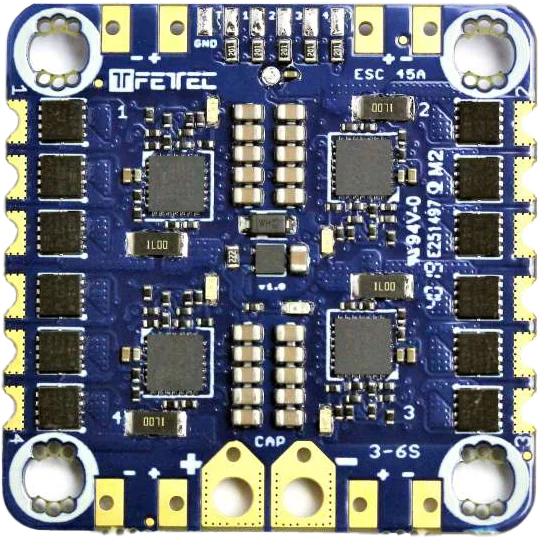
FETtec 4in1 ESC 45A
Check latest prices:
[Amazon]
[FETTec]
Recommended to use the spike absorber with 6S:
[FETTec]
FETtec 3-6S 4in1 ESC 35A
- STM32G071 @ 64MHz
- Over current and over temperature protection
- Sine wave commutation
- 128kHz PWM
- Automatic input signal detection:
- Dshot 300-2400
- PWM
- OneShot 42/125
- OneWire BUS with up to 8kHz looptime (one cable for all motor signals and Telemetry)
- Active current limiting @ 35A
- Kiss and Betaflight passthrough
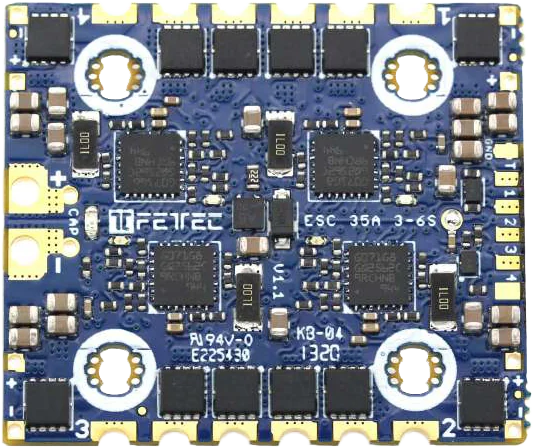
FETtec 4in1 ESC 35A
Check latest prices:
[Amazon]
[FETTec]
Recommended to use the spike absorber with 6S:
[FETTec]
Kiss FC Compatible ESC Comparison
The following table compares the main features of the Kiss and Fettec ESCs that are compatible with Kiss.
| Parameter | Kiss 25A | Kiss 32A | Kiss 4in1 | Kiss 24A | FETTec 45A | FETTec 35A |
| Operating Voltage | 2-5S | 3-6S | 2-5S | 2-5S | 3-6S | 3-6S |
| Processor | M4 @ 80MHz | M4 @ 80MHz | M4 @ 80MHz | M4 @ 48MHz | STM @ 64MHz | STM @ 64MHz |
| Current/Temp protection | Current / Temp | Current / Temp | Current / Temp | Current / Temp | Current / Temp | Current / Temp |
| Sine Wave Commutation | Yes | Yes | Yes | Yes | Yes | Yes |
| DShot | 2400 | 2400 | 2400 | 1200 | 2400 | 2400 |
| OneShot | 42/125 | 42/125 | 42/125 | 42/125 | 42/125 | 42/125 |
| OneWire | No | No | No | No | Yes | Yes |
| Current Limit | 25A | 32A | 25A | 24A | 45A | 35A |
| Capacitor | No | 6S only | No | 5S only | 5S & 6S | 5S & 6S |
| Number of motors | 1 | 1 | 4 | 1 | 4 | 4 |
Kiss ESC Comparison Table
What ESC should I choose for my Kiss quad?
It is clear that the industry has moved towards 4 in 1 ESCs and having personally built drones with both types, I think 4 in 1 ESCs are certainly the way to go.
They have many benefits over separate ESCs and the only real drawback is that if one ESC blows, you need to replace the whole board.
However 4 in 1 ESCs have become much more reliable and this will not be a problem if you select your components correctly.
Personally I have already been on this journey already and my personal preference is the FETtec 45A 4 in 1.
If you are paring this ESC with 6S on a 5-inch or 6-inch frame, you should be golden. Just don’t forget the spike absorber for 6S!
I have been running it with Xing Cyber 2207.5 1777KV motors and Ethix S3 props and it flies beautifully!
With that said if you want to build a larger quad like a 7-inch, you might want to consider the larger Kiss 32A individual ESCs.
Conclusion
In this article we have discussed mostly all of the ESC options out there for a Kiss quad, stopping short of the all in one solutions.
Hopefully now you have a good idea as to which ESC is right for you.
If you are still trying to decide, my advice would be go for one of the FETtec 4 in 1 solutions. Go ahead and check the price on Amazon here.
Thanks for reading and best of luck with your Kiss quad build!